Today let’s look at why Digital Transformation is misunderstood, how Enterprise Service Management enables Digital Transformation, and where ITSM fits in. And we’ll stack them all up together, and draw a groovy timeline from ITSM to Transformation.
Update : After reading this, you may want to dip into a new related article which describes a set of Portable Core ESM Practices which can be taken into any business unit to easily get started with Enterprise Service Management.
The excellent Itsm.tools site recently published their survey results summary of the hottest ITSM trends for 2021. This has the number one voted hot topic for 2021 as Digital Transformation. Following that, down at number 5 there is Enterprise Service Management and ITIL at number 6.
Reading that article reminded me of some frequent conversations about common understanding of some of industry terms. I’ve been in many meetings where the question gets asked:
- “What the heck is digital transformation anyway ?”
Then, that reminds me of the question:
“Is Enterprise Service Management basically the same as Digital Transformation?“.
That then leads to questions about the relationship between ESM and ITSM:
- “Whats the difference between Enterprise Service Management and IT Service Management?”.
- “Are ESM tools unsuitable for ITSM usage?”
Uh. OK. Today, let’s nail this. Usual massive disclaimer applies. All the following in Ian-terms, translating what I’ve heard and said into my own preferred simple summary. Trying to cut through the noise.
Imagine we’re in a meeting room together with a whiteboard. Here’s how I would answer those questions. You are always welcome to disagree of course. That’s OK.
Let’s start with Digital Transformation.
Digital Transformation really comes in Two Flavours
Some of the confusion here comes because people use the term in two different ways. So let’s give it two different names.
1. Strategic Digital Transformation.
Strategic Digital Transformation is changing the overall operating model of the enterprise. Transforming from traditional, maybe bricks-and-mortar, to an online, transactional or cloud based business model. This is all about changing the whole enterprise into a Digital (not Analog) model.
This is the digital transformation that Gartner, Forrester and many others talk about at a CIO/CEO/Board business strategy/pivot level.
Strategic Digital Transformation changes the focus of a whole business.
Next, there’s another level of Digital Transformation. To distinguish it from the Strategic Digital Transformation, lets call it➖
2. Operational Digital Transformation.
This is the one that changes how people work, Using a combination of new technology, lots of Automation, and Workflow, AI, ML, this level of Digital Transformation changes the way that people work, and the type of work that they do.
Operational Digital Transformation changes the day to day doing-of-work. This is required to take place when a business undergoes a Strategic Digital Transformation.
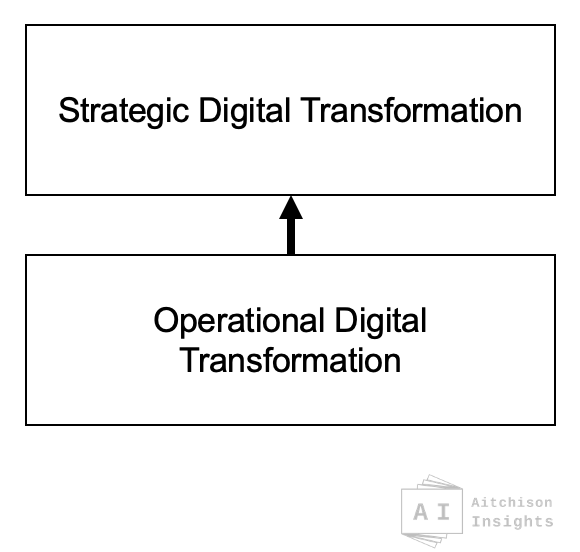
This is the ‘digital transformation’ that department heads, managers, tool vendors, consultants and service management people talk about a lot.
Operational Digital Transformation Changes How We Do Work.
It is possible to perform operational business transformation without strategic digital transformation. However it is probably impossible to succeed in strategic digital transformation without operational digital transformation taking place.
Now let’s dig deeper. One of the ways to execute Operational Digital Transformation is by implementing Service Management technology and practices across all parts of an enterprise…
Enterprise Service Management (ESM)
ESM enhances how people work, with focus on how a business unit or department delivers Value to the customer/consumers of that business unit, whether internal or external.
Using technology is a fundamental part of this of course. Simple examples such as workflow, systems of record, self-service channels, requests, incidents, changes, knowledge. Definition of value and service. It’s all about the purpose of a a business unit in delivering that value to their consumer/customers/employee. ESM enhances how people work in any department or function.
Because the way people work has to change to support Strategic Digital Transformation, introducing Enterprise Service Management can directly drive the mindset and working practice changes needed to enable Digital Transformation. This is how Enterprise Service Management enables Digital Transformation.
If HR want to publish an FAQ or offer a Chat Bot to the business to answer HR questions 24/7, that’s ESM.

So, finally what and where is ITSM in all this?
IT Service Management (ITSM)
ITSM is a form of Enterprise Service Management, as executed by IT. It delivers value to the consumers/customers/employees that use technology to do their job (aka… everyone). It is very well documented, and very well defined in great detail with best practice models and frameworks such as ITIL. It’s huge.
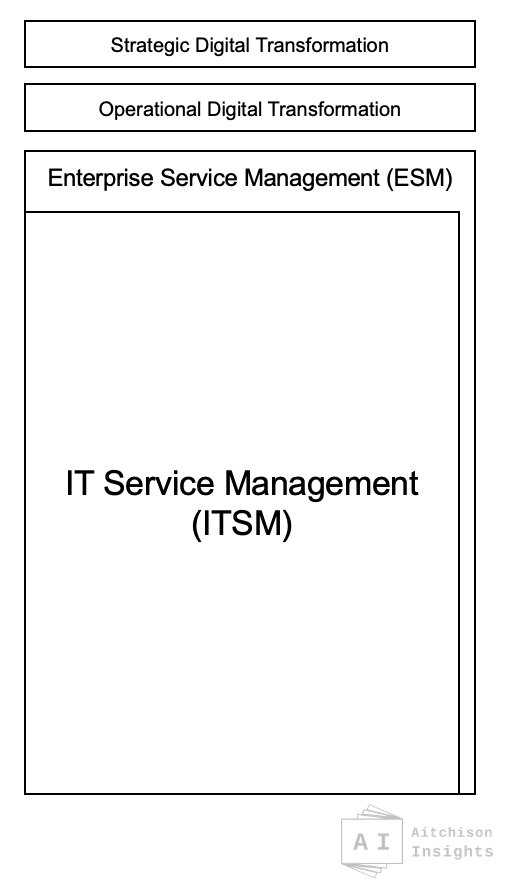
Yet in terms of the Digital Transformation stack, ITSM is a subset of ESM. ESM is the superset of all ‘X’SM.
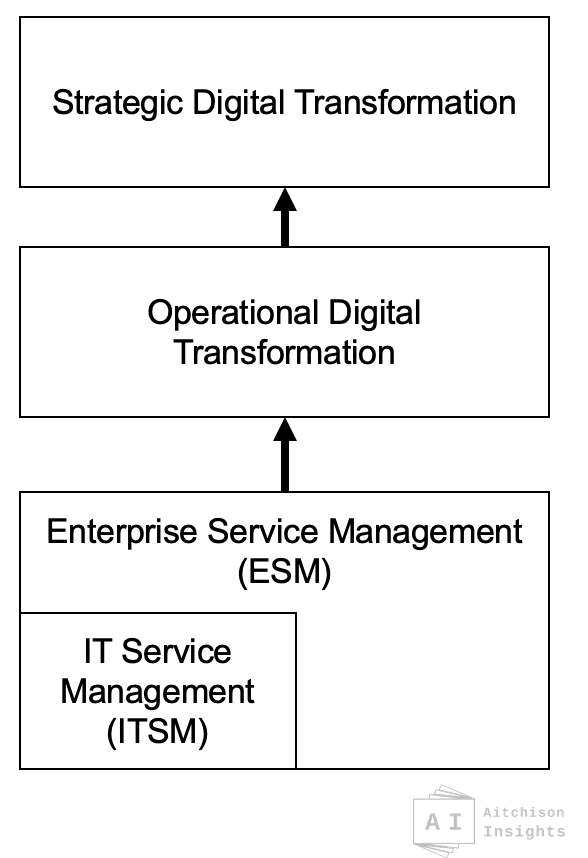
This point may be contentious. many folks usually describe ESM as only ‘ITSM outside of IT’. Some (oh, hi Gartner!) say it is all ITSM no matter who is practicing it.
I would ask the question – what happens when new best practice service management guides for other business functions start to appear (as they surely will)? Imagine an HRSM and FMSM and CSSM, each separate from ITSM. As they appear they would all have to sit within ESM, alongside ITSM.
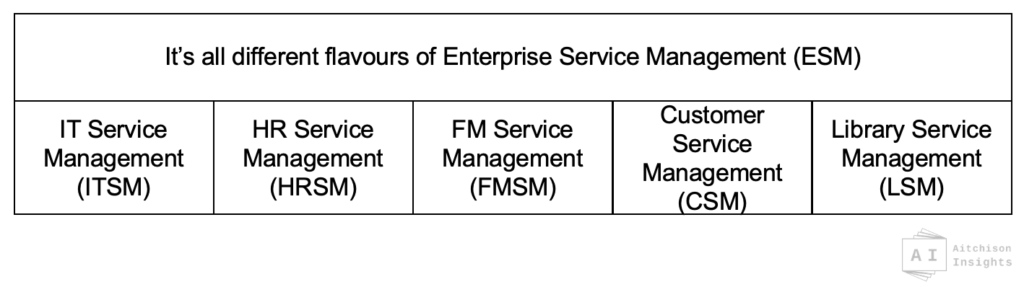
Although, since ITSM is so big and deep and wide it might be more like this:-
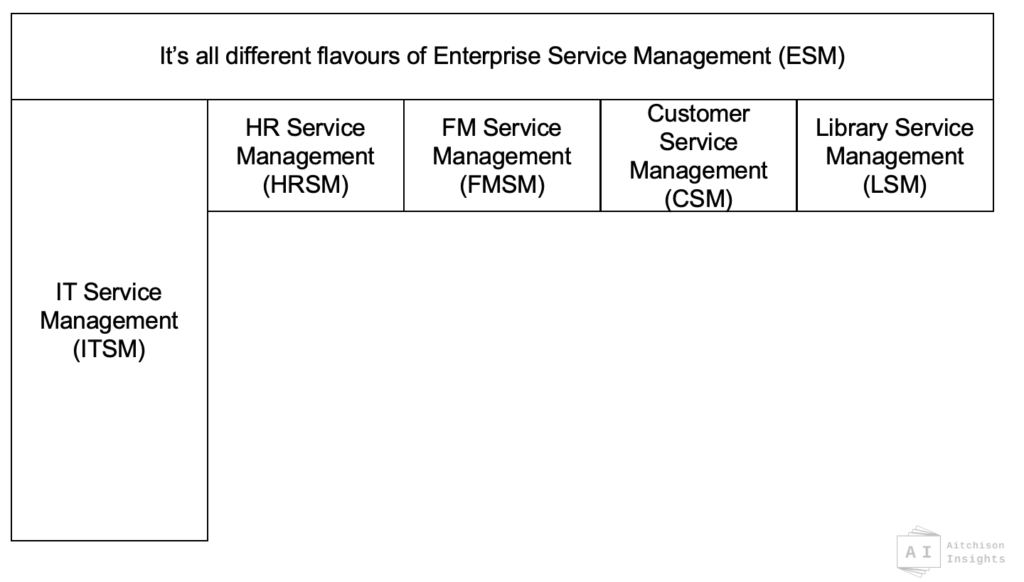
Certainly most ESM beyond IT is using ITSM tools and practices. It all started from ITSM. But to insist to an FM manager that it is still called ITSM when practiced by Facilities Management is a bit like saying Rocket League should be called Football (soccer).
Also it’s not either ‘Enterprise’ or ‘IT’. IT is part of the Enterprise. That’s the whole point.
Anyway, <breathe>, that aside, ESM is very powerful and widely adopted outside of IT. And this is why ESM tools are usually perfect for ITSM
Let’s get beyond that tricky one. Roll with me on this.
A Digital Transformation Journey
Finally, for fun, let’s put those together in a Digital Transformation Journey picture. Does this work? Yes I think it does. Here’s the journey organisations go through from ITSM-only, to achieving Strategic Digital Transformation

A few key points further
- Don’t think that ITSM above is ‘small’ or insignificant. It is only smaller than the other boxes to show that ITSM is a subset of all ESM. If you were to draw the size and breadth of defined practices in each area it would look more like this.
- I don’t think you can have good ESM without ITSM. There might be some cases where businesses do not have their own IT function at all. But then ITSM is just being outsourced one way or another. Everything starts with IT. (would that be ITverything?)
- I believe that you can’t really achieve Operational Digital Transformation without implementing ESM in some form. Yet Operational Digital Transformation also needs more than ESM alone. Maybe the diagram should be like this?

Anyway, that’s enough for now.
if all this gets you excited (really?), I strongly recommend connecting with the VeriSM body of work. It’s not the same as the above – which is all my own personal brain-dump – but VeriSM does talk well, in detail, about achieving enterprise Digital Transformation through Service Management
After reading this, you may want to dip into a new related article which describes a set of Portable Core ESM Practices which can be taken into any business unit to easily get started with Enterprise Service Management.
Even More reading? Having consumed this, now take a look at The 3-layer Model for IT Business Transformation.
Overall, did this make sense or was it just confusing madness? See how Enterprise Service Management enables Digital Transformation? Let me know back on the Linkedin post I put up about this, or back in Twitter.
Image by Vinson Tan ( 楊 祖 武 ) from Pixabay



0 Comments