There are three distinct, conceptual layers of thinking and technology required for successful automation for IT business transformation.
We know that successfully implementing IT-Business/Service improvement projects can be hard. Vendors talk of enhanced workflow and automation providing easy time and efficiency saving, yet – as with most IT/Business challenges – the devil sneaks in when you open the door to the detail. And you can be sure there is lot of detail needed when changing the way that people and technology meet to get work done.
In this article I describe three technology layers required to really manage and change a business using IT. Many IT organisations may be using one technology, stretched and repurposed across one, two of three of those conceptual layers. However this can make their implementations rigid, fragile and non-resilient. Also it may force vendor lock-in, and may ultimately lead to longer-term project failure
This is a tools&technology angled post this week. Very much all about Service, Automation, ITSM, ESM. Also – full transparency – I’m not 100% sure this is accurate. It’s something I’ve kept coming back to this over recent years, and it keeps coming back up. So, what the heck, let’s get it documented and see if it stands up to scrutiny.
No, This Isn’t About ITIL
There is an interesting discussion to be had about whether any of this is represented in existing guidelines and best practice frameworks. I see overlap both into ITIL 4 and maybe some VeriSM too. You may see others. But this article isn’t about mapping to ITIL 4, the service value system, value chains or practices. That is for another article maybe. This one is about the tools you have (or maybe need) to be successful, irrespective of whichever model you choose to adopt and adapt.
Anyway, let’s get to it.
The Three Layers of IT Business Transformation Technology
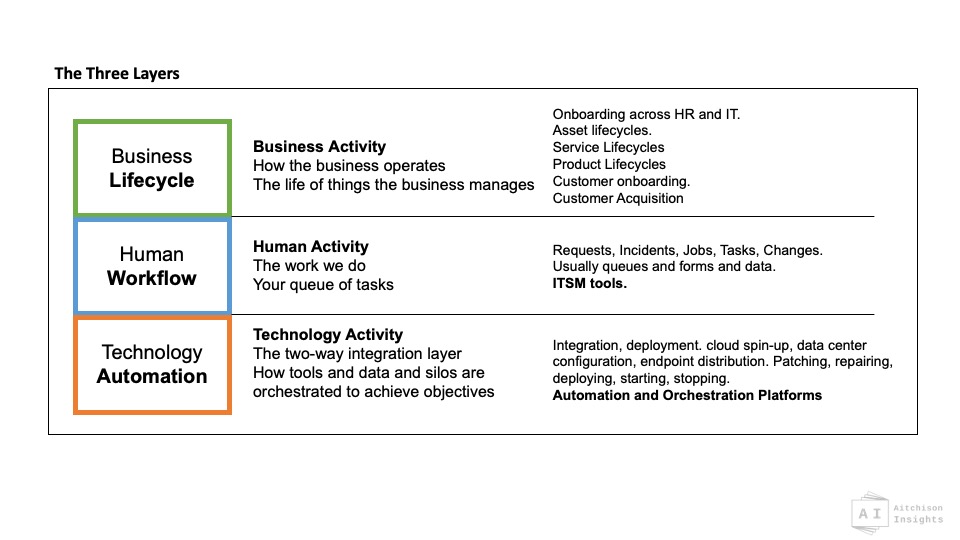
Here are the three levels or ‘layers’ you need in place to define, manage and change how your business works with technology.

Each of these layers have a distinct purpose.
First, The Business/IT LIFECYCLE Layer
This is the end-to-end definition of the journey (or life) of significant objects, events, entities, things, people. Onboarding an employee has a lifecycle which moves the employee from pre-offer all the way through HR, IT, Security, Facilities, Training and and other departments. Also Assets have lifecycles from pre-purchase, through purchase, delivery, configuration, assignment, live-usage, repair, upgrade, end of life and disposal. Services have lifecycles from pre-conception through creation, operation and end of life. Many things we design to do deliberately, pre-considered, across multiple business functions can be described in the form of these Business Lifecycle/Processes.
Real business behaviour change can only take place at this level. This is where you redefine what the business does from start to end.
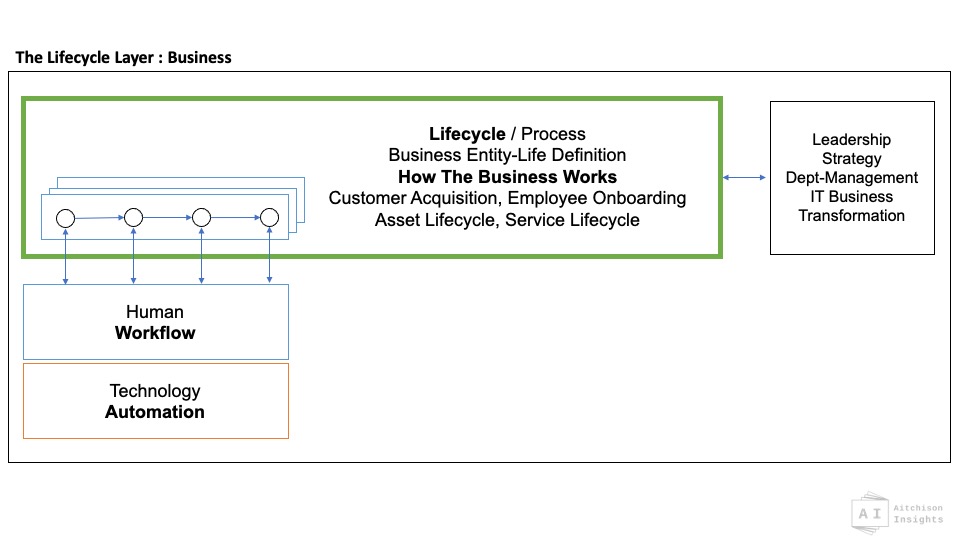
Lifecycle/Processes can be simple and quick or may be long lasting and complex. Everything exists within at least one lifecycle. Some exist within multiple lifecycles. And they inter-relate. For example, the end-of-employment lifecycle is a part of the full employee lifecycle but includes the asset lifecycle. The asset lifecycle includes recovery, wipe and reallocate the correct assets. But how you actually ensure the individual steps and actions take place to get from one stage to another is covered by the second layer
Lifecycles describe how a business works. The business includes IT, but is not limited to IT.
Is it a Maturity Thing?
IT Organisations starting out in ITSM often start a long way from here. They jump into Incident and Request workflow, self service. Then, over time they mature up into more complex practices using the same workflow platform. Finally they try to use that same workflow technology to describe their unique IT and business lifecycles. Totally possible, but possibly fragile and non-portable.
The more mature organisation already has these described and documented. Often they are in Visio or similar process-documentation tools.
However they need to be baked into the operational technology itself to allow strategic and operational management to view the progress and status of business operations. Also they must be able to change and adjust in real time. Literally, you can use this layer to change how the business works.
Next, in the Middle, is WORKFLOW.
Workflow is something specific to individual tools, and describes how individual items of work are done with those tools. Typically workflow involves windows, forms, fields, email, notifications. Calculations and rules. If Impact is X and Urgency is Y then assign to Z with Priority 123. If category contains AAA then suggest knowledge ABC. It’s creation of work, the queueing of work, and the doing of work to be done. Yes, that’s also Incidents, Requests, Changes etc. And that includes all the lovely self service portals, chat channels, bots and any other shiny modern experience interface.
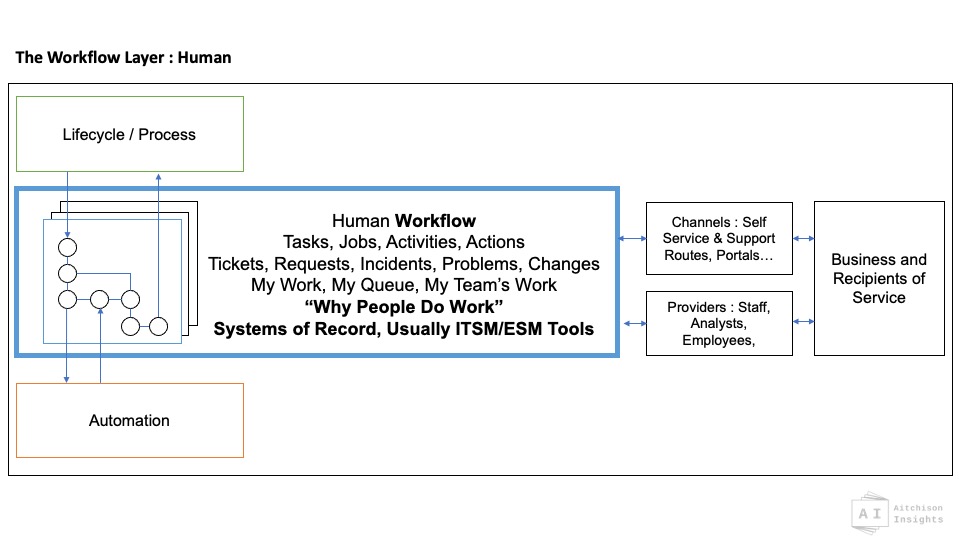
It is also very common for workflow to stretch well beyond IT across wider ESM usage into every part of a business. These are the interfaces into the work we need to do and a potential massive growth for the service management market if Microsoft doesn’t focus Teams much more into configurable workflow.
Finally, at the Third Level is the Automation Platform
The lowest layer is Automation. Here, a single technology platform layer describes how multiple external tools and data pass work back and forth to achieve coherent and joined-up outcomes.This isn’t just a simple ‘send an email’ level of automation. This is sequenced, two-way, rules and logic (and AI) based integration flows across multiple 3rdparty tools and technologies. It’s the: ‘create a new user in active directory, assign them into multiple business units’. But also ‘change their permissions,’ then ‘print out the office entry swipecard’, and ‘deploy the required set of applications’. That’s potentially all one linked sequence in the Automation later. It’s also those management platform actions such as ‘configure an AWS instance matching our standard definition’. Also ‘Start or stop this service’, ‘spin-up, spin-down’, ‘install this product to this target’.

But… Automation Has Workflow Though?
Confusingly, you should see automation-workflow inside good automation platform products. Don’t confuse this with the middle layer of human-tools workflow. Automation workflow is just a method to describe those intregration sequences and should be kept fully distinct from ITSM/ESM workflow.
The automation layer sits across and above the tools that very technical administrators use to do complex IT work. It’s sequenced and orchestrated two way flow. Not only between the tools and technologies below, but passing back and forth to the layer above.
You can be sure these Automation orchestration layers are already well known and well used. This is what’s behind many hyper-automation and cloud management platforms. However, only in a minority of cases are the automation actions taking place because of the ITSM/ESM tool (Workflow layer). Only in an extreme minority of cases is that Workflow taking place because of the Lifecycle position of the customer or the service or the asset.
The two-way factor is essential here. Your need to be able to see that your request (workflow) is waiting for automation, which has started…. is in progress… has completed… and now moves your workflow on to the next stage or next person.
Let’s Put It All Together
So here they are in one diagram together.

Now that we’ve got those 3 defined and drawn in scrappy diagrams. let me make one more point, just in case it’s not clear. THESE SHOULD ALL BE REAL, PRODUCTION TECHNOLOGIES that are integrating back and forth in near-real-time with each other. None of this should be documentation only, or require a human intervention to handoff from one layer to another unless that is part of the defined workflow.
You cannot successfully and consistently make big transformational IT/Business automation change without engaging across three layers.
Is Anyone Already There Yet?
Is anyone doing this? I’m going to go out on a limb and say:-
1- Most organisations do already have the the middle layer with their ITSM/ESM or ITAM toolset.
2 – Some organisations have some of that lower Automation layer. Most have the individual tools of course, but often not-integrated or only point-integrated into their ITSM/ESM workflow. That is viable but not transformationally-scalable. Maturity brings a common platform that sequences the automation.
3 – Very few have the top layer as a distinct capability or technology. Sometimes it’s baked into the ITSM/ESM workflow tooling. Again, viable, but fragile unless supporting a distinct lifecycle design model separate to ticket workflow.
4 – Fewest of all have all three operating, integrated together. Those that can do this are able to :-
- Change business behaviour from the top
- Enhance human experience in the middle
- Support that with technology improvements at the bottom.
How Was It for You?
So there you have it. The theoretical three-layer business transformation automation model. As I said at the start, I’m not yet 100% sure this is an absolutely accurate description, but it keeps on coming back up in conversations time and time again.
Does it make sense? Could this work for you? Is your experience or perception different?
Let me know what you think. You can add a comment below or back on the posts about this on LinkedIn and Twitter
And Finally, Whatever Next?
There are a few follow-ons I could see from writing this.
1 – How can vendors make this all much simpler? There is no doubt that all mid enterprise organizations have already shifted away from expecting infinitely configurable and highly complex towards wanting solutions that are prebuilt, fast time to value, and reduced choice. This is the massive opportunity for those that get it right.
2 – What about AI and ML? Artificial Intelligence and Machine Learning plugs perfectly into this model. I just have chosen to exclude that topic from this description to keep it simple. That’s a great opportunity for another article of course.
3 – How does this map into ITIL 4? For me this is was tech-tool-purpose description. I suspect the ITIL expert crew can map some interesting similarities into some of the ITIL 4 publications. I do know that the Creative Deliver Support (CDS) guidelines talk about some of this, but not in this way.
4 – And of course, which vendor have the tools which fit into each layer. It feels over-ambitious to expect the full 3-layer stack from one vendor, and indeed, keeping each layer separate allows a mix-and-match-and-change approach. Yet I think that those that could provide this could open a route for real next-gen IT/business management, improvement and competitive advantage.
<end>



1 Comment
Are You Implementing The Wrong Automation? | Aitchison Insights · 11 February 2021 at 11:35 am
[…] of course, much transformative innovation comes from… Automation. Read about the 3 layers of Process, Workflow and Automation here. I’ll be writing more about […]