Digging deeper into the implementing Objectives and Key Results model, let’s look at how and why OKRs work, the tools you need, tips, and the risks to avoid when OKRs are used in the real world. This article continues the topic of new and better ways to define and achieve real world improvement-success.
It also builds upon two previous articles : Outcomes over Activity and OKRs for Execution.
Ready? OK, let’s jump in.
First, What Are OKRs, and How Do They Work?
OKRs are made up of Objectives and Key Results. I’ll describe each separately first.
Objectives
An Objective is a described goal that an individual, team, department or business aims to achieve within a defined period of time.
Objectives are aspirational, and often describe a business destination. A state the business wants to reach. At the highest, maybe at the corporate/CEO level, objectives these might be as simple as the following.
- Grow the business
- Retain happy customers
- Retain happy staff
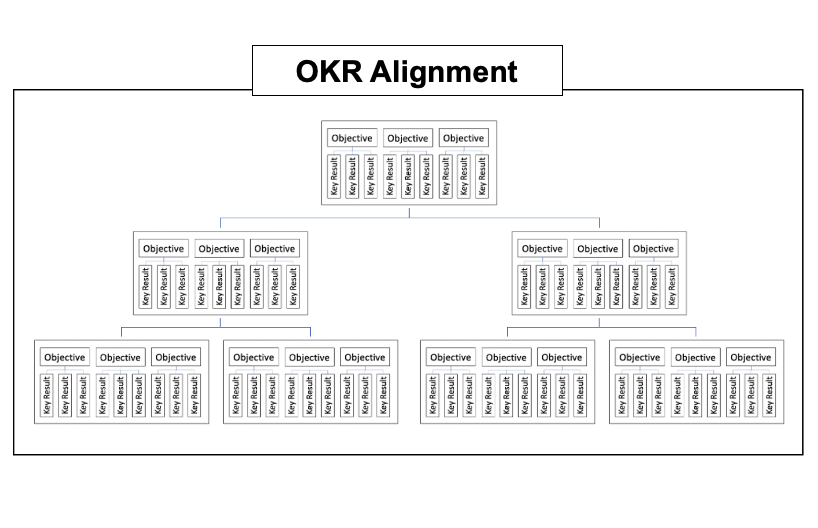
Those might be the top level Objectives for a business. Then, across the whole business, all departments, teams and individuals then have their own separate Objectives, which are specific to their work and their aspirations, but that do support Objectives higher in the business, all leading back to the top level objectives.
If every individual employee executes on their Objectives, then – in theory – the business should achieve it’s objectives.
Key Results
However without a way of measuring, how do you know you have achieved the destination? Well, that’s where the Key Results come in.
Key Results are measurable, specific metrics that are used to prove that you have achieved an Objective.
All Objectives should have Key Results. Combined together they are OKRs – Objectives and Key Results.
Taking our examples above, lets add some Key Results to make 3 sets of OKRs for a business:-
O1:Grow the business
- KR1 : $10M in new bookings
- KR2 : 1000 new customers signed up
- KR3 : >10% of customers buying additional products and services
O2:Retain happy customers
- KR1 : +95% customer renewal
- KR2 : 200 happy customer surveys
- KR3 : 20 new public reference customers
O3:Retain happy staff
- KR1 : staff turnover below 5%
- KR2 : all staff trained on OKRs
- KR3 : all staff have career plan documented
And from here we could start to drill into every business unit and department and further into teams. Just as one example, supporting the above, HR might have the following OKR.
HR O1:More Happy Employees (maps-up to Retain Happy Staff)
- KR1 : Published 3 monthly summary reports produced from exit interviews for 100% of leavers in that month
- KR2 : 1 worldwide employee survey completed and results shared with the business
- KR3 : Staff turnover reduced to 3%
And so on, across every function in the business. Like a big pyramid, or the roots of a tree, connecting business-strategy aligned OKRs into everything that everyone does.
All OKRs Apply to a Specific Defined Time Period, and It’s Usually a Quarter.
The sort of improvement work that OKRs suit tends to require some weeks to achieve. But a whole year lacks the ability to be agile, to course correct, to change plans. 3-month quarters are perfect.
You Really Can’t have OKRs without a defined time period.
The great thing is you can build a whole improvement or change roadmap around a series of quarters, and use OKRs for each quarter to focus on the primary achievement required to get to the next quarter. Each set of OKRs targets you to build the required foundation for the next phase in the roadmap.
OKRs Come in Multiple Sets, and it’s OK to Miss Some
Next, it is important that you set have multiple sets of OKRs within a time period, with the ambition to achieve most but not all of them in that period.
- Why not all? because OKRs should be aspirational, some which are essential, some which are a stretch.
- There is a good discussion around OKRs not striving for unrealistic ‘moon shots’ which are incredibly hard and most likely to fail, but to instead strive for a few ‘roof-shots’ which are a stretch, high ambition, and could be achieved.
An ideal combination seems to be 3-5 OKRs for a quarter, where 80% are the important fundamentals and 20% are those ‘and, we’re going to stretch for …’ roof shots.
Key Results Should Be Measurable
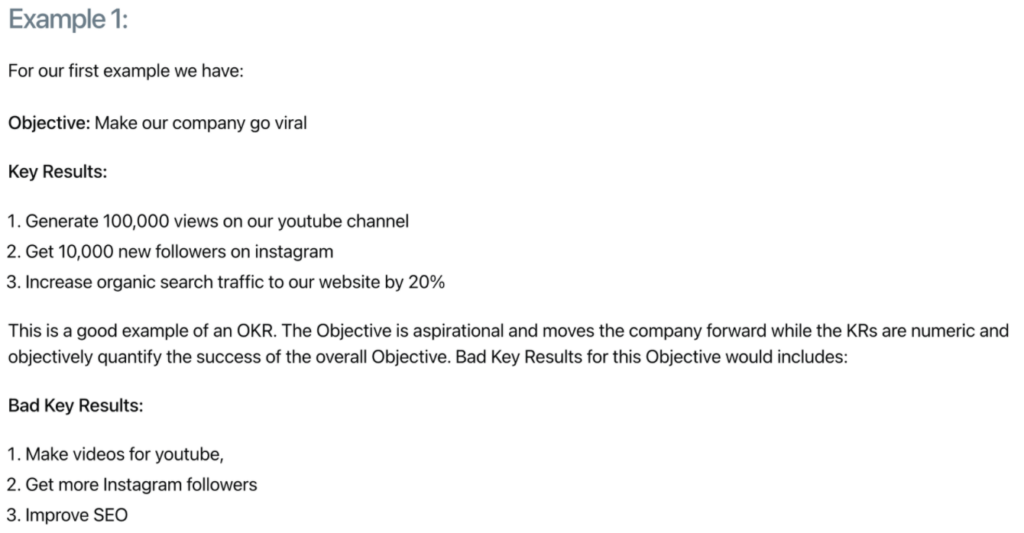
Here’s a screenshot (credit:I took it from the Weekdone website). It describes a good and a bad Key Result. This is important to get right. Note that bad KRs cannot be measured.
Ah… This Sounds Big and Complicated and… Hard.
Yes, the full top down approach can be hard to get right and requires dedicated focus and effort in many areas. If you assume it’s all or nothing, then that’s a massive business culture change program. This can be why implementing OKRs will fail.
The good news is that you can still take the best bits of OKRs and used them within departments, with teams or individuals or managers, and still be successful even without top to bottom business alignment. Implementing real world OKRs does not mean implementing everything from A – Z. Just what works.
I’m a big advocate of owning your own space and making that a success. If the rest of the business follows, then great, but don’t feel you should sit still and no nothing because everyone elsewhere is not signed up. Lead, take advantage of that leadership. It’s called operational innovation.
What About SMART goals – Isn’t this basically the same thing?
Not exactly. SMART (simple measurable achieveable relevant timely) is a reference to set any goal and make sure it is ‘good’. But SMART alone lack aspiration, business alignment, strategy, roof-shots. If SMART is a knife, OKRs are the kitchen. Or even the whole restaurant.
Why Do OKRs Work?
OKRs work because of a few key concepts that make a big difference.
Measurable Destinations
They combine aspirational destinations with quantifiable measures. You can specify the goal of achieving an outcome, and the metrics that prove whether that outcome has been achieved.
Eg, Improved User Experience = KR1: time to login, KR2: productivity, KR3: number of clicks, KR4 : number of incidents, KR5: Survey Feedback.
They are Collaborative and Inclusive
OKRs are agreed with the teams that will be achieving them. The objectives should be aligned with business goals and approved by the relevant leadership, but the descriptions, the method of measurement (the KRs) are totally devised by the team.
This brings the teams totally onboard. They own their OKRs. The team agree to set a course to the same destination, not have activity imposed upon them.
They Encourage Self Sufficient Decision Making and Rapid Progress
Because the teams ‘own’ their OKRs, many questions or decisions within a quarter period are immediately answerable. “Should we now decided to do X?” = “Does it support achieving the OKRs?”. If the answer is Yes then it is obvious and easy to move forward, not clearly decide not to.
They are Business Aligned
In theory, any OKR objective can be mapped to a higher level objective. The ideal vision of OKRs is that it starts with OKRs at the very top of the business, and everything cascades down from there through every department and every team.
You should be able to Map-Up. (Why does a Product Team have an Objective of ‘improve product quality’ ? because it maps-up to support retaining happy customers, and probably also growing the business and in extreme cases even retaining happy staff).
They are Visible and Public
Each team should be able to see their OKRs within eyeline easily. Not saved only in a word document. but printed out and stuck on the wall for each indioviodual. this works..
And also they should be visible to the rest of the business. Everyone should share openly their OKRs. this helps with collaboration and alignment and general business support for what you are doing and provides a very visible measure of success. If you have an intranet page for your department, put each team’s OKRs for the current quarter up there.
Also, each team should also know their Manager or departmental OKRs. It helps to share widely what is important and what success looks like.
So what’s this got to do with Product Management and Service Management?
Well, my experience is that implementing real world OKRs can work for aspirational modern product management and could do the same for service improvement.
Want to make something new, do something better, improve something? Set some OKRs.
I’ve seen OKRs work extremely well with Product teams and can see the same with Service teams. (As you may have spotted from this blog, the convergence of Product and Service is a real thing).
IT / Service Leaders: You can introduce OKRs for your department, with different OKR sets into service teams. You don’t need the full business topdown, just roll them out within your department alone to drive the right outcomes.
Product leaders: Exactly the same, the team-based, iterative nature of modern product work these days is perfectly formed to pick up OKRs and run with them. Many tech companies already do.
You Can Do It! What You Need to Succeed Easily with OKRs
Now you are fully briefed, let’s look at the basic tools you need to get started.
- An editable text document (for each team, showing This Qtrs Approved OKRs. Also copies for next qtr’s draft & then approved. previous qtrs old copies).
- A spreadsheet showing progress on all OKRs for all teams. See point 6. Routine below
- A shared location to save these. So everyone can see them
- An OKR ‘coach’ – someone who can help individual teams tune their OKRs to get them right. This isn’t in the wider OKR best practice as such but I’ve seen clearly that in a mid to large organisation you need someone that can guide, advise and inspire people to produce good okrs.
- Training – Explain how it works. Light training is enough for everyone, but you need deeper explanation for key leaders. They have to be on board and supportive.
- Routine. This is essential. Leadership meetings across a department every 2 weeks to review progress across all OKRs with team leads, but also individual team meetings every two weeks review progress and plans to achieve that quarters OKRs.
You don’t need dedicated tools but it’s kind of fun if you do. Replace your spreadsheet and work documents with cool tools that provide dashboards and charts and reminders,
OKR Gotchas: What Doesn’t Work
If you are implementing real world OKRs, watch out for these Big-Scale and Small-Scale Gotchas that may trip you up.
Big Scale Gotchas
- Some business functions simply don’t operate in an OKRs mindset. As an example Salespeople have a clear single number to hit. That is the definition of success for them, and they may struggle to move to work in the same way as Improvement teams. Accept that it can be very hard for all parts of a business to align on working this way.
- Topdown is really hard. Thats a big business culture change. It’s a lot more than sending out copies of the book and an internal webinar.
- Watch out for a situation where an individual is in 2 or more teams, working to 2 or more sets of OKRs that contradict each other. It’s possibly correct to say that people should only every have one set of OKRs that they are working towards. But, again, that gets complicated at scale.
All of the above support my initial point that going all-in can be hard, and you don’t have to go all-in to be successful. start with just your department, team or even just yourself and work up.
Small Scale Gotchas
Even at a smaller scale watch out for the following:
- They are not so great for maintaining the status quo. Its not that they dont work that way, its juts that you lose the value if you are not trying to get somewhere new.
- If you don’t review and approve the OKRs, it’s possible for the teams to build OKRs that are weak. This is where a combination of autonomy, management approval and an OKR coach is valuable
- Avoid annual OKRs. A year is just too long a timescale. I’ve been more successful setting annual simple “Outcomes” and then use quarterly OKRs that map to achieving those Outcomes. But the annual outcomes need to be very loose. A year is a long time and things change fast.
- Don’t Replicate, Map Up : should any lower level OKRs be literally the same as the business OKRs? No, you should avoid this trap. For example, if your top level business OKR is Grow The Business, then a product, sales or marketing team should not have the same objective of ‘grow the business’. Their objectives should be relevant to their function, achieving destinations or outcomes specific to what they do. But they should also support or be able to be mapped up to the top level OKRs.
Read More. There’s loads of good resources out there on OKRs.
Here’s a nice page with lots of different examples for different businesses departments and functions : https://www.workfront.com/strategic-planning/goals/okr/okr-examples
There’s plenty of cool tools for managing OKRs. This is a favourite of mine : https://weekdone.com/product. they have a ton of other resources too: https://weekdone.com/resources/objectives-key-results#What_are_OKRs
And of course, The Book. “Measure What Matters” by John Doerr. His website and more details about the book are here. Essential reading for OKRs.



1 Comment
Are You Implementing The Wrong Automation? | Aitchison Insights · 11 February 2021 at 11:22 am
[…] And then, how do you set and progress the objective of reaching new outcomes, step by step, quarter by quarter? How do you actually execute? You’ll want to read about the Objectives and Key Results model here. […]