Whether a software vendor or a customer, you may encounter different opinions on product roadmaps. Today I’m digging into why some people feel product roadmaps are dangerous, and how that also exposes a conflict between agility and certainty.
This is continuing my mini-series of articles ‘On the Nature of Roadmaps’. The previous post shone a light on the hidden values of product roadmaps for product organisations, software vendors and their customers. And yet, not everyone supports the use of roadmaps.
- The Pro-Roadmap Contingent believe that roadmaps for a product (or service) is essential part of managing a product.
- The Anti-Roadmap Contingent see roadmaps as dangerous, damaging, old fashioned, and shouldn’t exist in a modern software product organisation.
Dangerous Roadmaps.
Here’s a quote from Marty Cagan the author of the Inspired product management guidelines from the Silicon Valley Product Group. You can see which of the two groups he sits in.

Yikes. Sounds bad huh? If you browse online you’ll find many Product Management / Product / Development people who are very vocal about the dangers inherent in Roadmaps. The Anti-Roadmap Contingent are many in number.
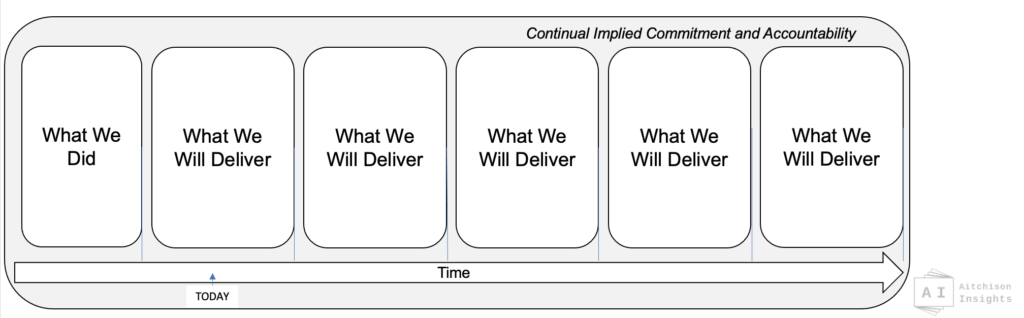
Why would a product organisation not want to communicate how it planned to bring new value to customers over time?
Let’s unpack the Anti-Roadmap position. Why some people think roadmaps are dangerous, and then why that is exposing a conflict between agility and certainty.
Obvious disclaimer: this will vary by industry and organisation. I am referring to the enterprise software B2B market, not mobile games development or social-platform-startups which may be very different.
“We Are Agile”
It used to be that product creation was a long, slow, and heavily documented process. Hundreds of pages of Definition and Proposal and Specification and Requirements were produced. Luckily the world shifted away from this ponderous Waterfall approach some years ago. No one wants to go back. there’s not enough trees in the world to keep printing that much unread paper.
Today all modern products are all created and grow in healthy agile ways. Implicit in the very core of agile development is the principle of decomposing big work into small steps, with each step influenced by the progress of the previous step. So, in some ways this is about ‘working it out as you go along’. A series of iterations or sprints, deciding each next step based on the progress of the previous step.
That’s not a criticism. It’s a recognition that complex software development often requires you to get deep into the work itself to really understand how the work will be completed. And this is OK, it works and works well.
Mistakes are expected, experiments are important. Getting things wrong is part of the journey to getting to the best place. Thankfully there’s a lot less documentation and a lot more mockups and prototypes.
Unfortunately, the high agility, small steps and course changes of modern product creation do not sit well with detailed long term future deliverables described in a roadmap. Seeing unknown deliverables 12 to 18 months in the future, the product teams will have low confidence on their ability to deliver. They lack solid detail of What and the How and the When to achieve that future.
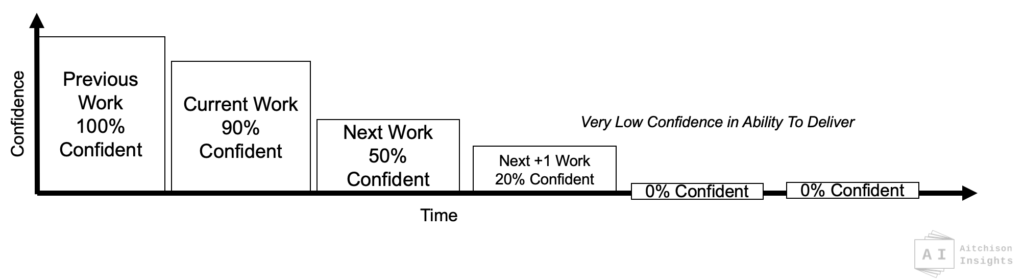
No wonder there is some concern over the effectiveness of roadmaps. So why bother with a roadmap at all?
“We’ll Surprise You”.
Can you deliver the right value, in a highly agile, modern, product world if you don’t have a roadmap?
Marty Cagan (Inspired, SCPG) recommends the following instead of using roadmaps.
“ensure your product organization has a compelling product vision. Ensure that each product team has a clearly defined, prioritized set of business objectives”.
and
“Now empower the product teams to solve the business problems the best way they see fit, and see how many of your teams surprise you with their results”.
Let me replay what Marty said there. The suggestion is that Product Teams should be ‘surprising’ their own business and their customers with their work. There is no roadmap, they understand the vision and they decide what is needed as they go along…. “Surprise! Look what we did!”
Actually, there is a lot of sense in this and a clear value in fostering innovation and creativity. The best people to identify the highest value new capabilities are a strong Product Team, closely connected in with customer needs, and able to adjust and evolve as they progress. I’ve seen it work and it works well.
A Delightful Surprise Needs To Support Wider Needs
But it only works only at one level. On a wider scale there has to be business and market confidence and certainty. Confidence from board or investors, through executive leadership and strategic business plans, down to sellers, enablement and training plans, communication, support, marketing. And most importantly of all, from customers who need the assurance that their investment was wise and that their needs and plans are understood, and will be (or will not be) addressed by their vendor.
Future timescales are everything in this conversation, and good roadmaps always have disclaimers on the variability of future plans over time.
But even with the best disclaimers, putting future deliverables on a plan still communicates intent. And intent implies accountability and a commitment to deliver on that plan.
So, of course, it’s no surprise that some agile product practices don’t actually encourage commitment? In fact it’s quite the reverse…
“We Don’t Commit, We’re Agile”
‘Commit’ refers to a firm intent. As an example, if I commit to delivering 6 pints of milk next Friday, you have my firm intent (even promise) that you will have milk. On Friday. And, if no milk arrives on Friday, something somewhere has gone wrong.
‘Accountability’ indicates that I am the one you should hold to account. It’s my great job delivering the milk (yay!). Or, my poor job in failing to fulfil on my commitment to you to provide the milk.
Clearly there is a disconnect. Agile products teams see future plans that imply both commitment and accountability. However that future work is not yet started and the teams naturally have low confidence on the What and the How. And the When.
To avoid these risks – and I’m wording this carefully here – some of the widely followed agile development guidelines started to guide dev and product teams to actively avoid Commitment and Accountability. Don’t commit and become accountable for something in the future that you cannot yet understand, and do not yet have high confidence.
On one hand, of course that seems fair, but taking it further can also open the door to a more negative culture that supports the view that ‘we are agile, we don’t have commitments to deliver anything’.
And, as the customer, you have no idea of when – or even if – your milk will ever arrive on your doorstep.
SCRUM Guidelines Changes
Hey, don’t shout at me. Even the the authors of the widely adopted and very successful agile development methodology SCRUM recently recognised they had been encouraging avoidance of commitment and accountability. This quote from Jeff Sutherland, talking about the recent SCRUM Guidelines changes in 2020 …
“Self-organization was widely misinterpreted to mean that agile developers do not have to meet commitments. We hope self-managing will create a more mature attitude towards meeting the needs of the organization”.
‘…A more mature attitude to meeting the needs of the organisation’. That says a lot. Literally from the authors of SCRUM itself.
Other changes in the SCRUM Guidelines in 2020 to address this:-
- The use of “Roles” is now changed to “Accountabilities”. Small wording change, big significance. Why do you think they did that?
- The word ‘Commitment’ (which had been deliberately removed from SCRUM in the past) has been carefully and deliberately re-introduced at a number of points.
You can read more about this here. https://www.infoq.com/articles/changes-2020-Scrum-guide/
With a history of ‘avoid commitment’ it’s not surprising that many in product/dev organisations viewed roadmaps with suspicion or downright dislike. For some people a roadmap and its related implications are a mechanism built to make them unsuccessful. They are dangerous.
The conflict between agility and certainty.
So that brings us to the conflict at the heart of modern product creation for established B2B software vendors. We now understand why some people think roadmaps are dangerous, but we can also see a deeper fundamental conflict, between agility and certainty.
- A modern B2B product business needs clear future plans with future timelines. Vision, to Strategy, to Execution, to Future Delivery, to Proven Ability to Execute. This is about direction, consistency and reliability. Certainty.
- Modern agile product practices need agility, small steps and direction changes that may not arrive at those same long term destinations. This is about speed, innovation and creativity. Agility.
Let’s squish the two diagrams above together on one timeline.
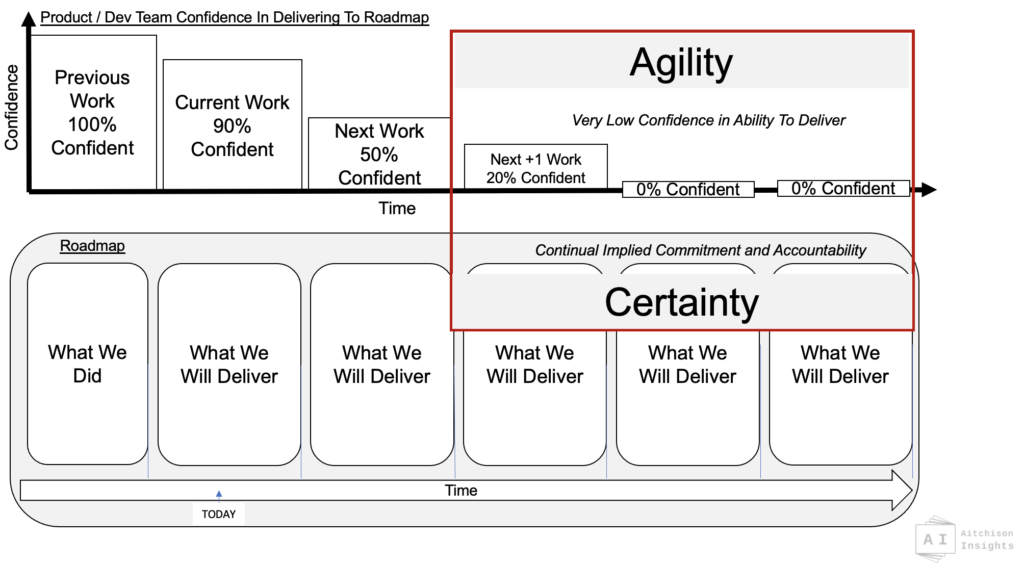
See the conflict? You need both. It’s no wonder that SCRUM encouraged ‘Avoid Commitment’ and Inspired (and others) were promoting ‘Don’t Use Roadmaps’
But these are two very valid business needs. You can’t be successful with just one. If those two needs are not very carefully and consciously balanced and worked together you risk two outcomes:-
1 – Either a roadmap becomes little more than a disconnected wishlist and ‘a graveyard of failed ideas’.
2 – Or, with no roadmap, a product business could live only in the present, where customers and the vendor are unable to base any business decisions and actions on reliable future plans.
There Is A Good Solution
The good news is… that it is possible to balance roadmap benefits with agile advantages. In the next article in this series I dig into how to get the very best of creative, modern product practices, while still communicating a roadmap of exciting future plans to achieve business outcomes.
Sounds fun huh?
So that’s an awful lot of words about dangerous roadmaps and the conflict between agility and certainty. Got an opinion? Share your thoughts on all this down below, back on my LinkedIn post, or over in Twitter.
Image by Fathromi Ramdlon from Pixabay


0 Comments