There’s been a lot of talk recently about roadmaps (See Boris Johnson and the Roadmap out of Lockdown). That’s inspired me to write about software product roadmaps, why we need them, why some people hate them, and what it means if you don’t have one. First we’re looking at the real value and benefits of having a product or service roadmap.
In this article I’m back to the art and science of software product management. However, my view is that Product Management and IT/Enterprise Service Management are similar and merging, so…
If you are a Product Manager, or in any role in a software vendor organisation, or, if you work with software vendors as a customer or a buyer then you may get good value from this.
If you are an ITSM/ESM person, this could still be useful. Just think of your SERVICES as your PRODUCTS. Do they have roadmaps?
Right. Onward. Today’s main topic is starting a mini-series on Software Roadmaps.
Fun Fact. Some People Think Roadmaps are a Bad Thing
In the software creation world there are two opposing views, widely contested and argued over as passionately as any other principle or belief system.
- The Pro-Roadmap Contingent: A Roadmap for a product (or service) is essential part of managing a modern product.
- The Anti-Roadmap Contingent: A Roadmap is dangerous, damaging, old fashioned, and should not be a part of modern software product organisation.
In a second post, I’m going to look at how the software industry got into this uncomfortable position, why some people hate roadmaps, and how to solve that problem.
But on this first article I’ll back up a bit and remind us of the basics:
What is a Product Roadmap?
A product roadmap describes the planned future changes or enhancements to a product(s), over a time period. Like a real map – or maybe a passage-plan – a roadmap communicates the ordered steps towards a future point for a product. Unlike a real map it also includes some element of timing to achieve that future point.
Usually, we see roadmaps show some form of future ‘releases’, with their ‘features’, laid out over a future timeline. But that can vary in style, detail and approach considerably.
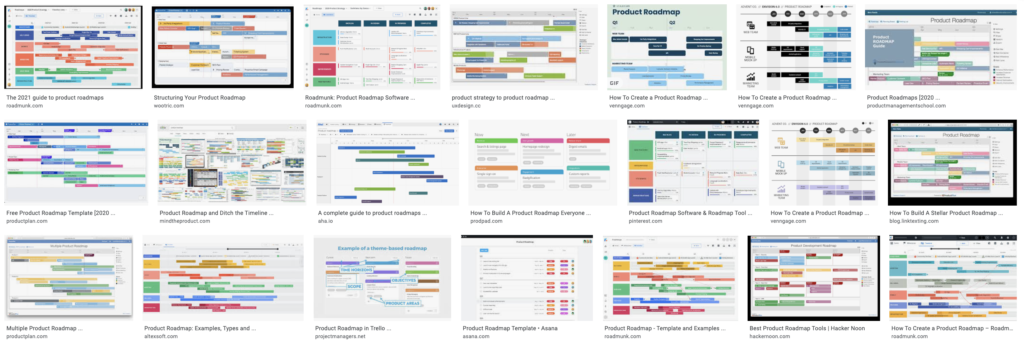
Ideally a roadmap is describing the intended route towards a product destination or business outcome for the customer of that product. Something that is attractive, better, faster, stronger… The key steps (release points or major features) describe how that destination will be reached, and the timeline to get there.
Those destinations at the end of the roadmap should connect your product or business strategy to your Vision.
(That’s a brief summary. This article is also not about How to Design or Execute on Roadmaps, there’s another future topic waiting to be published).
So Who Needs To See A Roadmap?
Everyone! Your roadmaps are for: your own vendor business, your senior exec, board, investors, technical support, consultants/pro services, customers, prospective future customers, industry analysts, technical internal, development, architecture…
Different audiences should see slightly different views and levels of detail across your roadmap. Today I’m talking about the most ‘standard’ customer-facing, internal communication roadmap typically used for any product or service.
What is a Roadmap Really For?
The benefits of a product roadmap are more than just ‘telling people what is in the next releases’. People tend to forget that outside of the basic information shown, Roadmaps also serve a number of very valuable purposes:-
Roadmaps Set and Limit Expectations
Roadmaps show what we plan to do and – crucially – what we do not plan to do. And when we do – or do not – plan to do those things. If everyone sees the same plan they all know what to expect and they also know what isn’t a part of the plan. This makes all people happy. (Showing that you intend to introduce sandwich-toaster-workflow will stop your customers, prospects and your own organisation from complaining that you do not have any hot sandwich features in your product. They know it’s planned.
Roadmaps Describe the Constraints of Finite Resource
This can be a painful one, but a roadmap can also subtly communicate the maximum volume, quantity and velocity of what can be done. If you are looking to insert something new into the middle of your a roadmap, it should be clearer to others that something else will have to shift out.
Roadmaps Ensure Alignment and Focus on Common Outcomes.
Just like a real map, a roadmap describes the route to a destination. How We Get To X. There is no doubt about where we are going. This is good for customers, for the whole vendor company, and for the product teams too of course. This is the big vision/strategy/execution fit and makes sure everying is facing in the same direction.
Roadmaps Build Previous-Execution Credibility.
Often people talk about only ‘whats next’, but your audience may not be aware of all the amazing things that have been delivered in previous releases. Always include a bit of the past and use roadmaps to communicate previous success and progress.
Roadmaps Test Ideas
Good roadmaps introduce some further-out ‘maybe’ items to gather feedback. (If you don’t get questions, discussion or any interest in a new bacon-automation feature then that helps assess that there is no demand of bacon automation).
Above all, Roadmaps Build Confidence and Support
This is probably the most important. If your roadmap is not doing this then it’s not working. You need trust and confidence from your customers, your business partners and the rest of your business that you know what you are doing and where you are going.
That all seems pretty clear doesn’t it? Why on earth would anyone say a Roadmap is a bad and dangerous thing? Well… that’ll be the next article on this topic, coming soon. It’s a good one I think.
EDIT : Here it is – Dangerous Roadmaps. A Conflict between Agility and Certainty
Want to know where else roadmaps appear? (hint – it’s ITSM): Read about why Batman and Robin always succeed with a Roadmap.
Got an opinion? Share your thoughts on all this down below, back on the LinkedIn Post, or in Twitter.
Image by Free-Photos from Pixabay



0 Comments